|
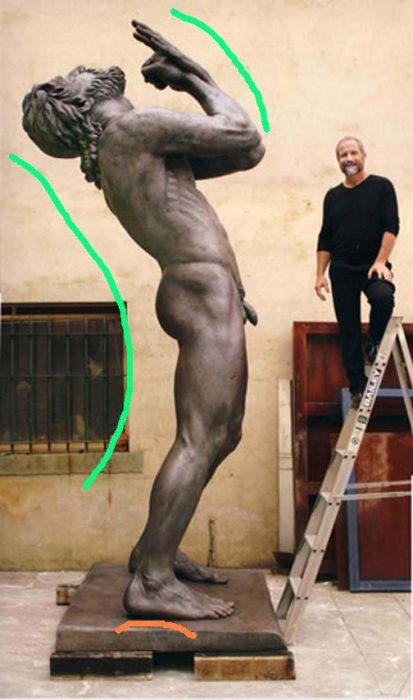
This is a male nude.
Many people are
uncomfortable with nudity in contemporary art. That is a shame
because the solitary nude sculpture is an ideal expression of
individualism.
Hold that thought as we
examine this sculpture.
We see a
larger-than-life-sized man, arching back, and his head thrown
back at an intense angle—the chin raised above the forehead. The
body’s tone is taut, yet there is relaxed fluidity from limb to
limb. He has the body of a world-class athlete, such as the
current tennis great, Roger Federer. The most prominent gesture
is the back of the closed fist meeting the open, extended hand.
An abstract aspect
of this sculpture is the arc of the entire body—from
the heel to the tip of the head. It conjures up the form of a bow,
or of a tree limb a limb pulled back. This, combined with the smack of
the hand, creates the sense of a springing force. The raised heel
is understated, yet very challenging for the artist—it would
be much easier to sculpt the feet flat-footed. The raised heel
shifts the lower body forward, balancing the backwards arc, and
enhancing the athletic litheness. This curve gently pushes
the crotch forward, giving the sense of unselfconscious ease.

When I started thinking about this sculpture, I got up from my
chair, went into the middle of my studio, and spontaneously
mimicked the pose—arching my back, and slapping the back of my
fist against my open hand.
My gut feeling was of being seventeen years old and coming to an
important decision to act.
All of us know the depressing quality of
procrastination, the inability to follow through. Thus Spoke
Zarathustra is the moment of coming to a resolution. Here we
have a man who is forever springing up. He conveys what the Nike
commercial recommends: Just Do It.
The artist, Peter Schipperheyn, explains:
“My figure could only be nude; the body is the ‘spirit’ clothed
by flesh, creation conscious of itself, the moment between being
and becoming.”
A friend, Lance Davey, who has
enjoyed playing the role of Henry V, described it
this way:
|
"Shifting the
hands down and getting the head in line shifted my
perception immediately. You go from
supplication...to 'potential kinetic energy'...It
looks as though he has drawn his body up and his
breath...
This EXACT
thing happens in Shakespeare's Henry V (though more
violently), the tempo and the building energy of the
delivery of:
"Now set the teeth and stretch the nostril wide hold
hard the breath and bend up every spirit to his full
height!"
It builds and builds and builds then peaks at
'height'... then WOOOOOOOOSH the balance tips and
out comes that pent-up energy with:
"ON, ON! You noblest English!"
That sculpture
I think is in that pause..." |
The real Zarathustra, the man who
inspired Nietzsche, was active approximately at the time of
Homer, pre-sixth century B.C.E. Zarathustra is known for his
formulation of the concept of free will and for his belief
that active participation in life, through good thoughts,
good words, and good deeds, is necessary to ensure happiness
and to keep chaos at bay.
The concepts of free will and active
participation dovetail nicely with Schipperheyn’s vision of
the sculpture. That vision came to him in a dream. Then a
friend with the right body type was willing to pose for a
smaller version of the work. The construction of the
monumental work began twenty years later, with a commission
by Dame Murdoch. The title came to Schipperheyn during the
process of making it.
To comprehend the full import of this
sculpture, it is important to grasp the meaning of two of
its elements: nudity and completeness.
Clothes in art are symbols identifying
the subject’s time, nationality, and position in the world.
They tell us about the subject. Think of Egyptian
sculptures and how the state and religious symbols of
staffs, ceremonial collars, and head gear drape the people.
But if we focus on the expression of the people, they come
across as stiff and formal, as if they are only stand-ins
for the role of king, priest, or god.
The nude figure is completely
different. Once the artist removes the status symbols of
clothes, we get to the truth of the human spirit. The artist
must show us the meaning of the work—not tell
us—through the sensual intimacy of body language and facial
expression. We might say that we are seeing the figure’s
psychology: how he is when alone with himself. The nude
extends the range of knowledge about the person; we witness
his intimate individuality.
The second characteristic is
completeness. Like nudity, completeness has symbolic
connotations. The complete, the whole, is what we generally
believe to be god-like. “We’re only human” is often used as
an excuse not to be whole and to indulge a human failing.
There is an amusing anecdote about Greek sculptors leaving a
blemish so as not to anger the gods with their figures’
perfection.
In Zarathustra, the whole body
is presented, from spot-on proportions to the refined
detailing of veins, toes, and fingernails. There are no
lobbed limbs, no mangled flesh, no deformities, no unhealthy
extra fat, and no Achilles’ heel.
To make images of such god-like,
idealized, nude human beings often provokes cultural
conflict, because there is little that is Christian, Jewish,
or Muslim about them. “You shall have no other gods before
me. You shall not make for yourself a graven image . . . You
shall not bow down to them or serve them . . . I am a
jealous God.” (Exodus 20:3-6) “[A] Muslim artist [is]
constrained . . . by the general prohibition preventing any
figural treatment of the divine or human countenance . . .
for only God can create.” (Islamic Aesthetics: An
Introduction, by Oliver Leaman)
Nude heroic sculpture must pose quite
a threat, to be dismissed by one of the Ten Commandments.
One puzzle about contemporary
individualism is that it seems to have no cultural identity.
Postmodernism and its art could be a symbol of freedom to go
your own way, including the freedom to shock and the right
to do almost anything. But is that really what individualism
is for?
It is interesting to note that the
cultures that embraced the heroic nude—Ancient Greece, the
Italian Renaissance, and many countries in the nineteenth
century—simultaneously made monumental advances in politics,
science, and philosophy.
If we are going to move forward into a
culture of flourishing individualism, then there is no
better symbol for its beginning than Schipperheyn’s Thus
Spoke Zarathustra.
-----
Michael Newberry
New York, April 2008
|