
Newberry Art Tutorials
Pure Colored Light
I love working pastel on dark paper for one important reason: the pastel being lighter than the paper directly creates a pure colored light.
The paper is dark brown Canson, 19 x 26″.
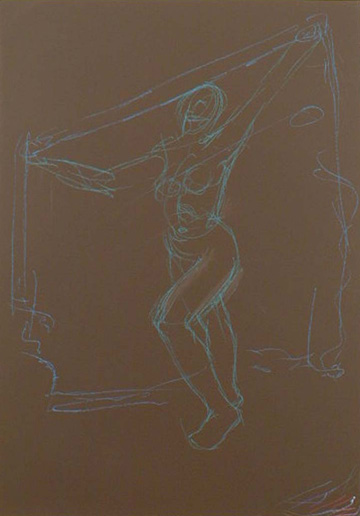
You can start with any color you like, but it is important that the tone of the pastel is only one notch lighter than the paper–just enough so that you can see your marks. The blue outlines here are Prussian Blue, one of the darker blues
Warmer or Cooler
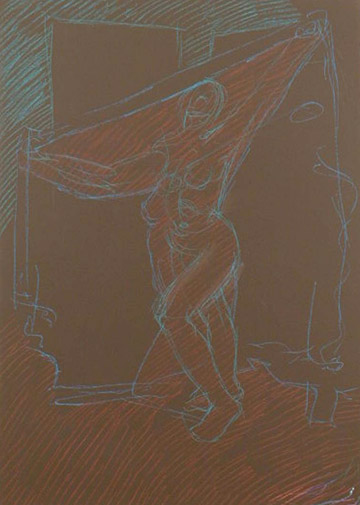
In this image, I am beginning to block out the entire paper. The background walls, in reality, are white and the floor is a wood floor. When I work with pastel, one of the things I ask myself is whether the color is warmer or cooler. The white of the wall is cool and the orange of the floor is warm. Then taking a cool dark color, almost any kind of blue or green, which is one step lighter than the paper, I blocked out the background wall. Then, with the same idea, yet with a warm color, a dark burnt orange, I did the floor, her body, and the shadow of the cloth.
Directional Hatching
My particular style of mark making with pastel is hatching. I like to keep the color as pure and direct as possible and layer different colors one on top of another to create nuance. It’s also important to leave some space between the hatching, to let the paper come through. There is limited “tooth” to the paper and if you solidly cover the paper, after about 10 layers the pastel won’t “take” anymore.
Incrementally and Carefully Adding Tones
The idea is to gradually add light and color one tone at a time starting with those dark tones just one step lighter than the paper. Here is the completed, blocked out image. The cloth in real life is Canary Yellow, and I blocked it in with a dark orange about two tones lighter than the paper – I knew it was going to have more layers of color added to it.
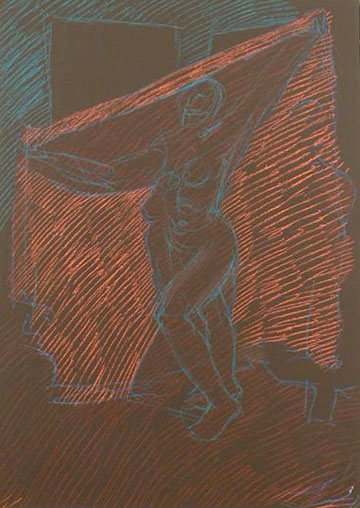
Now comes the lighting stage. My focus here is to add another layer of color in the light areas, one step lighter than what came before. Parts of background wall and floor are in dark shadow, I am leaving them alone.
Do a Layer and Move To Other Areas
I like to add one layer of light in an area, careful to step up the tone slowly, then stop and go to another area. Here I brought up the yellow cloth, then I went to the floor and to her body. Then I added a third light to the cloth and to her body. Notice the slight pinkish quality of her chest in contrast to the gold of the cloth.
Squint
One technique of looking I cannot stress enough is squinting your eyes to look about you–squint and compare with your drawing. Squinting keeps your focus on the essential tones of the light and shadow. In other words, it keeps your focus on the forest and not on the individual trees.
Erasing Pastel with Tape
Note about mistakes: Once you have layer of pastel down you can use transparent packing tape, lay it over the area you want to erase and gently rub with your fingernail, the same direction as the hatching, and lift off the tape. It will lift off the previous layer, be careful not to press so hard that you stick the tape to the paper and tear it.
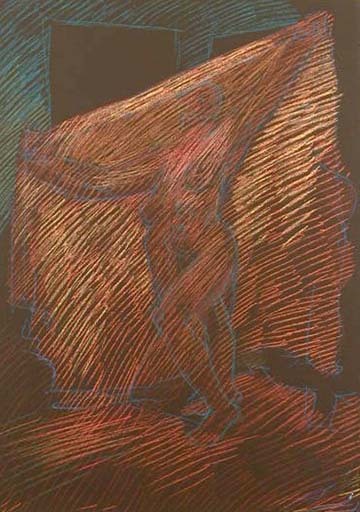
Here I stepped back to re-assess the drawing. I went back into the background realizing its darkest area was lighter than the darkest area on the floor. I added more light to the cloth and added more detail to the light hitting Kimberly’s body. And I add some hot color, red, to her left arm’s cast shadow.
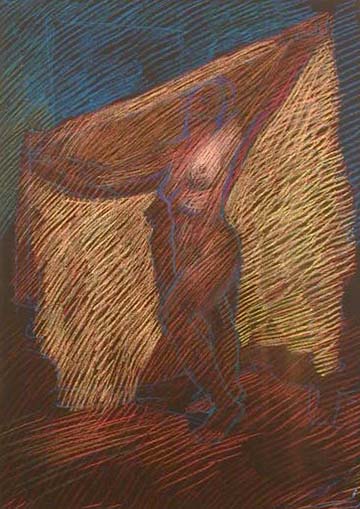
Our session was winding down. At this point, Kimberly could only hold up the cloth for about 20 seconds. Now was the time to blast the highlights! It takes some discipline to wait on the highlights, after all they are the first thing I was attracted to in the image. But, trust me, it is worth it.
Discriminate!
The biggest mistake artists make is after they get one great effect with a highlight they indiscriminately highlight other areas with the same tone and color. Mistake! Don’t do that. It kills the eyes’ interest.
It is imperative that you distinguish the color, intensity, and brightness of your highlighted areas. Here, the light on her breast was the lightest area, slightly pinkish. Next was the intense yellow highlight just left of her right breast. The third brightest was the deep yellow of the cloth above her head. And the fourth was the less intense yellow under her left armpit.
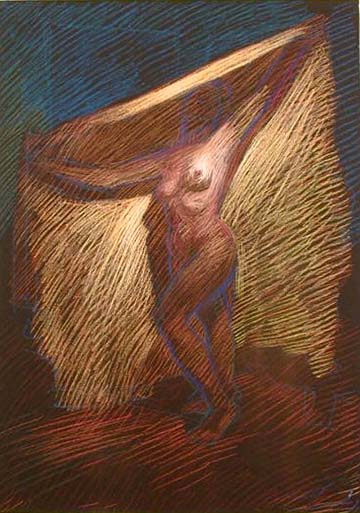
Pastel on dark paper will help you see light in a fresh way.
Michael Newberry
New York, May 2006
 Michael Newberry
One Reply to “”