

(Written Today) An Art Memoir: Depth, Light, and Love
Size Matters
Two years after the Pierre Hotel Conference, with its extraordinarily powerful intellectuals delving into the highs and lows of our art culture, I found myself at a well-known gallery just around the corner from the Pierre. The gallery was simple and understated, belying its wealth, with a few large rooms fitting for an elegant museum. It was the opening night of a solo show by a mid-career still life artist. I would have moved mountains to have my work in such a gallery—or so I thought.
I was excited to be there because I thought this show might mark the resurgence of figurative, representational art. There were about 15 to 20 still lifes, all 3 by 4 feet, with prices around $35,000. The crowd was sparse, and I had the opportunity to talk to the artist about his work.
I was a surprised that the artist appeared to be drunk, especially considering it was a career highlight—a solo exhibition in a beautiful gallery at the center of New York. Regardless, I showed him respect, and we spent about 15 minutes reviewing the paintings.
The artworks were beautifully done still lifes, with very sensitive drawing and subtle color harmonies. But there was one very puzzling factor: every painting had a huge white background that dominated the painting, with the actual still life being only about 12 by 16 inches. He could have painted these beautiful still lifes on a much smaller canvas and achieved a better composition, rather than his style of placing a small point of interest in the center of the canvas.
One painting in particular featured white alliums with their fireworks-like, explosive offerings rising up from a tall, narrow tubular vase. I laughingly shared with him an artistic insider insight that he was playing with the metaphor of a phallic orgasm. The artist had a completely blank, lost expression on his face and had no idea what I was talking about. Drunk or not it was inconceivable that he was having a professional art exhibition without understanding the basics of phallic symbolism.
Before the opening was over, I figured out that the $35,000 price tag was based on the size of the paintings. A 3×4′ painting would command a higher price per square inch, whereas a smaller 12×16″ painting would sell for about a tenth of that price. I was certain that the artist had compromised his aesthetic choices for financial reasons. I imagined him using an assembly line approach with 15 large canvases, all featuring nearly identical white backgrounds, and then focusing his efforts on the tiny still lifes within. Not only did this strategy maximize the square inch pricing, but it also saved him a lot of time.
This pricing strategy was fresh in my mind because I had just been searching for a loft in New York. Most available lofts were around 700 sq. ft., which was too cramped for a proper art studio, especially with large canvases. As the studios got larger, the sq. ft. price diminished, making the 700-sq.-ft. spaces the most expensive per sq. ft. It was a shame because NY had so many great spaces for artists, but contractors cut them down to size for profit, compromising ideal art studios.
I first noticed this price-per-square-inch pattern in New York. Unfortunately, when artists engage in it, it not only undermines their artistic integrity but also disrupts their creative process. Instead of focusing solely on making their art the best it can be, they begin to compromise their artistic vision, often lying to themselves to justify these compromises. This shift in focus severs their commitment to creating art purely for its own sake.
As I saw how the New York gallery managed to inflate the prices of paintings by increasing their sizes, I was happily surprised that a brilliant architect solved a tremendously complex problem in the blink of an eye.
My East Williamsburg Loft
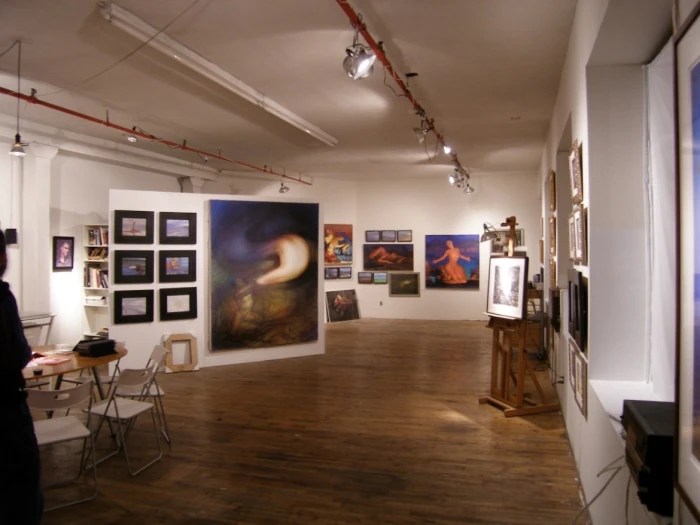
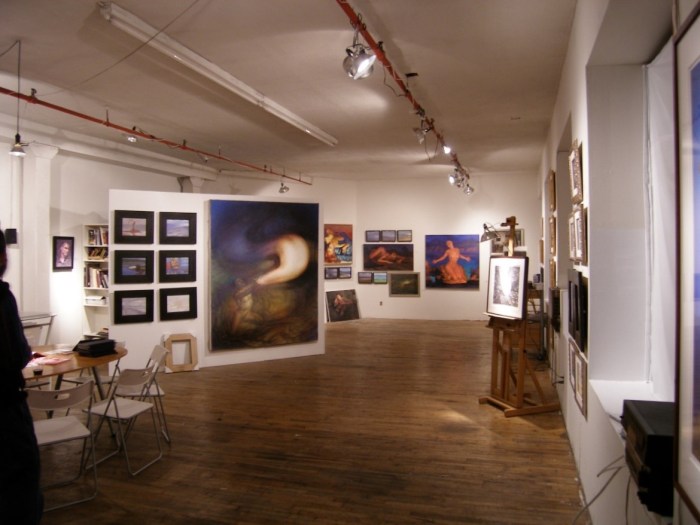
I found a 1,700-square-foot loft in East Williamsburg, New York. It was on the middle floor of what had been a textile factory. The space was perfect—rough enough that I didn’t need to worry about spilling paint. I even discovered a couple of darning needles wedged between the floorboards. The loft had a row of windows that let in indirect light, and unbelievably, it was located only 15 minutes from Manhattan via the L train, which went directly to Washington Square. Read more …
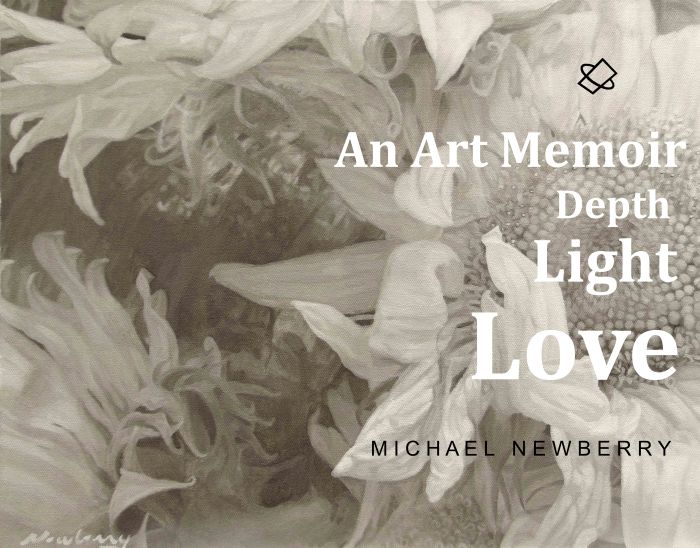
To be published in 2025.
 Michael Newberry