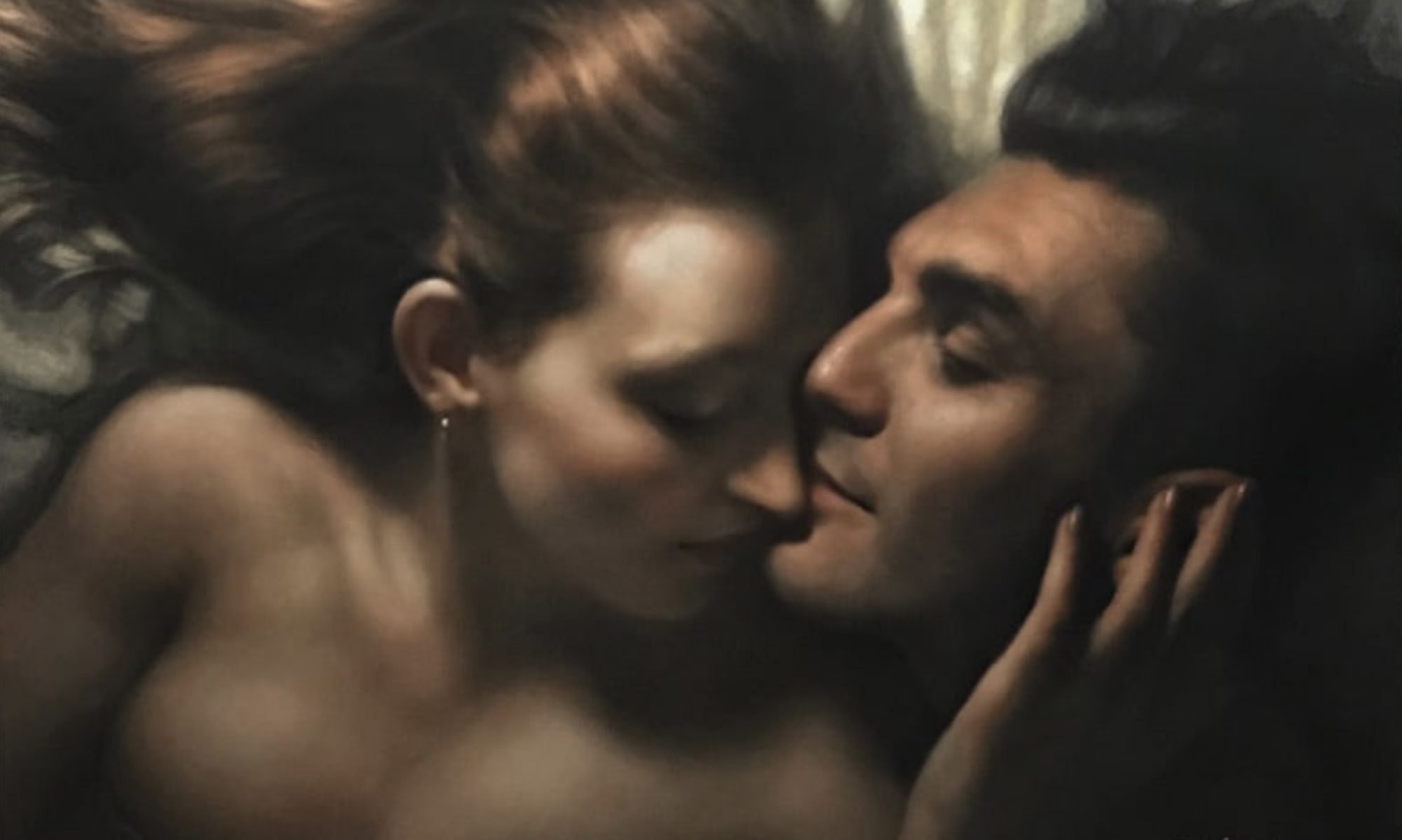


by Michael Newberry
Long before religion, long before language, long before civilization, there was the artist: shaping the emergence of human cognition from tusk and colored grit. It was art that fine-tuned, integrated, and supported free will, imagination, thought, sensory perception, and feeling—universal forces that every human possesses. By contrast religions, local customs, political and racial affiliations, and the haves or the have-nots push humans into tribes, it is us against them. Silly, when every person shares all of the same core attributes as every human since the dawn of humanity. And that is what art speaks to, the universal in all of us.
The birth of figurative art 40,000 years ago, with Lion Man, is the first unambiguous joining of perception, emotion, and thought. Lion Man is a result of real-life perception of male proportions and a lion skin and its head; the emotional romanticism of imbuing a human with lion powers; and the artist recreating his thought/vision of a lion-caped man. Figurative art is the literal, visible, and factual anchor of our species’ cognition.
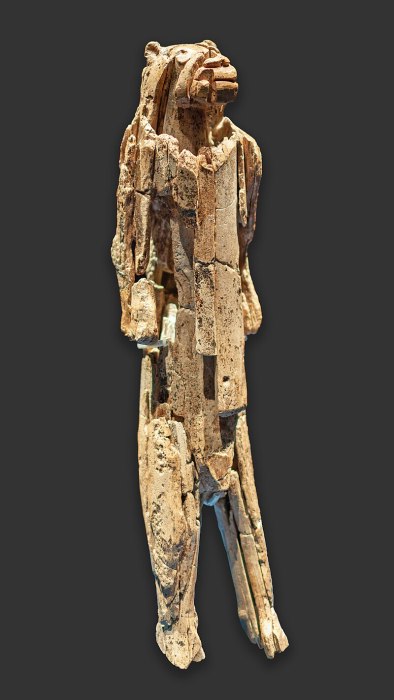
The Lion Man of Hohlenstein–Stadel, c. 40,000 BC — The first merging of perception, emotion, and thought: the dawn of figurative cognition. Photo by Dagmar Hollmann, Wikipedia Commons.
[Cognition, as I use the term, is a system of awareness that unites perception, emotion, and thought. Perception is sensory awareness; emotion is a visceral, physiological sensation, a biological detection system; thought is the intellectual process of forming and working with ideas. Together they form the field of human knowing i.e., cognition.]
It is my theory that the act of making figurative art brings cognition into being, rather than the other way around. The artistic process starts with a vision, then proceeds like this: if it doesn’t look right, the artist will reference their visual perception of real life; if it doesn’t feel like the energy of galloping horses, the artist will use emotion as a guide and checkmark; and if it doesn’t convey the right meaning, the artist will re-think it until it captures the right concept.
The magical thing is when the artwork communicates to the viewer, the artwork embeds a code into the psyche of the viewer—it injects them with cognitive super powers. When the viewer grasps the whole, they are transported, it feels real: their mental, emotional, and perceptual potentials become activated and integrated. These very things empower conceptual thinking, planning, abstracting, passionate motivation, and sensory excitement—every corner of their being is pinged, leading to a cascade of elations. Figurative art is not evidence of cognition but I argue it is the source of cognition; it is the beacon that calls on one’s entire being. And the most epic phenomenon is that the embedded code can be transferred from one to another through art, even from 40,000 years ago— it is as if prehistoric people were communicating in real time to us.
We know that there was music 35,000 years ago, the Hohle Fels flute made out of a bird bone, but we don’t know what they composed. Likewise, we don’t know what stories they told, but we can assume they did. It is only through sculpture and painting that we have direct, living proof of their art and cognition.
But tragically, for over a century, our shared and magnificent artistic legacy has been psychologically attacked by the kind of individuals Hannah Arendt described as embodying “the banality of evil.” They operate through vicious PsyOp approaches and acts (there is also good PsyOp, but not used by them). The way for us to inoculate ourselves against them is easy: the key is to embrace figurative art and genuine art forms, because these are the foundations of our cognitive health. (My understanding of PsyOp is informed in part by Boone Cutler and Lt. Gen. Michael T. Flynn’s framework for Fifth Generation Warfare, which describes how influence operations operate on a psychological and cultural level.)
Unfortunately, the 18th-century philosopher Kant psycho-eviscerated art in his book The Critique of Judgment. It has the rare distinction of being the most influential aesthetic philosophy of the 20th century, yet a book that almost nobody has thoroughly read and studied except for a few nerds such as myself. He treated beauty, figurative art, as something meaningless, decorative, and craft-like, yet his alternative to art was aesthetic nihilism: formless and violently anti-cognitive, which I believe laid the foundations for postmodern art and gave intellectual justification for psychotic predators. Without irony, Kant called his aesthetic nihilism the Sublime. (I discuss in depth the connection between postmodern art and Kant in my Kant chapter of Evolution Through Art.)
When figurative art is psycho-eviscerated by gatekeepers (museums, money launderers, critics, and the State Department), it becomes an insidious weapon that destroys our integrative capacity to see, feel, and think; it destroys our cognitive agency.
Whether we like it or not, there is no escaping that cultures and civilizations have either implicit or explicit state-sponsored art, from Sumerian to the present, that identifies their culture more than any policy could do. But what could possess the CIA to champion artistic vomit (Pollock) as a symbol of American culture, and all the other variations of anti-art, Dada, non-objective art, and postmodernism? This is well documented in Frances Stonor Saunders’ The Cultural Cold War: The CIA and the World of Arts and Letters, which details their promotion of Abstract Expressionism.

Jackson Pollock, No. 5, 1948—The collapse of form into psychic turbulence: the triumph and tragedy of disconnection. Photo by Taken from Art Market Watch.com., fair use.
We think their MKUltra was evil, and it was, but their takedown of figurative art, the guardian of human cognition, and its 40,000-year legacy is perhaps worse because you destroy people from the inside out. By championing non-objective art, it is my belief that the CIA engaged in ethnocide (see my article: The CIA Weaponizing Abstract Art and Its Fallout). This would have never been possible without Kant’s method for taking a great and noble concept (the Sublime) and replacing it with its opposite (nihilism).
A great historical parallel to our current situation is the rise of the Golden Age of Athens (c. 480–404 BC). The Athenians faced physical annihilation when the Persians under Xerxes I sacked the Acropolis in 480 BC—an event described in Herodotus, Histories, Book VIII—yet they preserved their mental and cultural integrity, which allowed them to rebuild into greatness, exemplified by Aeschylus (525–456 BC), arguably the greatest playwright of all time. The key difference between then and now is that we live in an age of psychological warfare, and our enemy is from within. Its assault on figurative art, cognition, and meaning is aimed at the very core of humanity itself. But we authentic artists and supporters, having faced psychological annihilation and not only survived but thrived by rejecting postmodernism, return stronger, clearer, and less naïve than any other Golden Age.
This resurgence is much more than a reawakening. Figurative art is not a style or an ideology; it is a natural part of our DNA. The human instinct (as seen in three- and four-year-old children drawing recognizable things) creates and responds to representational art. No force can extinguish that unless it literally exterminates humanity.
A true and radiant Golden Age has been flourishing since the 1970s. Contemporary figurative art has moved beyond the postmodern gatekeepers. The figurative artists of today, those working with integrity, independence, courage, and skill, are leading humanity out of the lowest aesthetic point in 40,000 years of human history. To every poet and artist alive today: you are the builders of our current Golden Age. Well done.
 Michael Newberry