

I saw a post on FB on the end-of-year exhibition of students at the Florence Academy of Art, and I really wanted to love it, but didn’t. The works are clearly accomplishing a high level of polish and technical precision. Their students have learned unerring proportion, light, and form. But none of them had a unique voice; each drawing looks like it was done by the same “hand.” The academy’s idea is that when they have mastered classical drawing, then later in life they can develop their own style. A fatal flaw in this is that the classical style is so deeply embedded when they are in their formative years that they never shake it. When every drawing looks the same, when the marks follow an institutional formula instead of a personal response to the figure, individuality disappears. Their approach completely defeats the purpose of being an artist: art isn’t about being an automaton, a consequence of following rule-based instruction without deviation. Rather, it’s about the technical principles that free an artist to express a unique, individual soul.
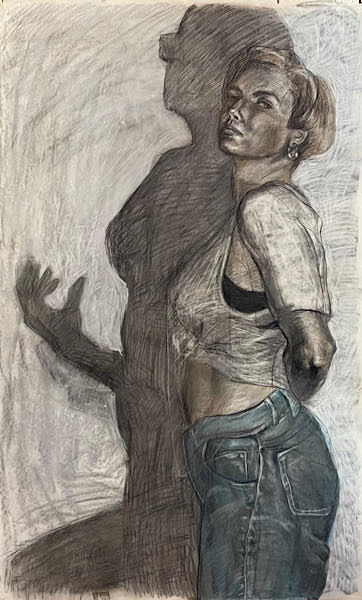
Above: Hefferlin, Self-Portrait, 1993, charcoal, chalk, pastel. Lifesize.
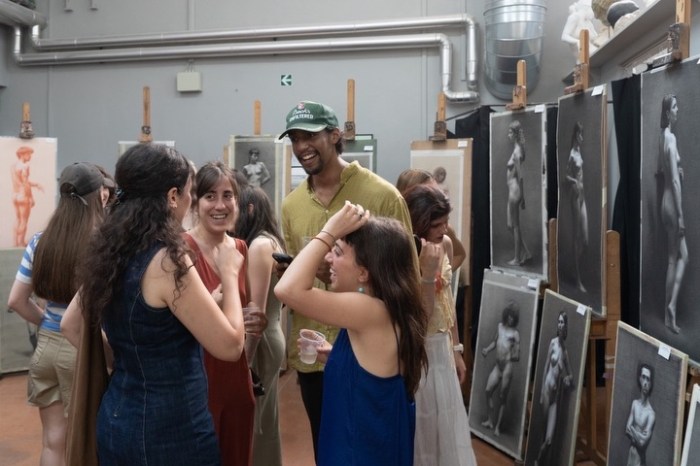
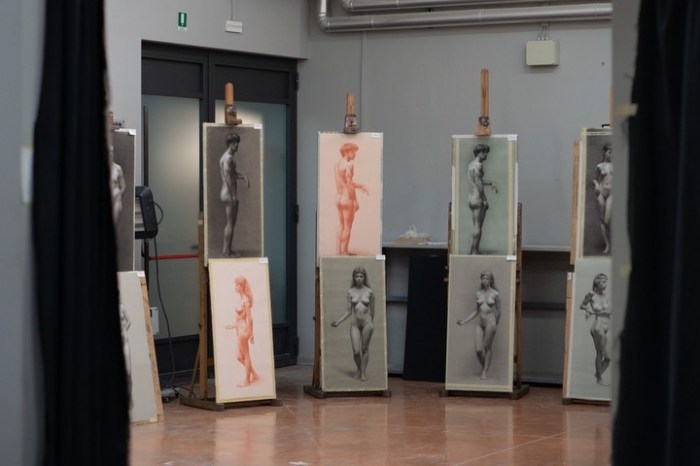
Student photos by the Florence Academy of Art, shared publicly on Facebook.
By contrast, one of my students, Melissa Hefferlin, created a drawing self-portrait that has form, proportion, and light, plus an individual spirit. When I taught life drawing at Otis College of Art and Design, one technique was devoted to my massage technique of mark making, which is for the student to imagine their thumb massaging the figure, and then draw mimicking their thumb’s movements. Shockingly, my 25 students did the assignment exactly yet every drawing had an obvious unique tactile feeling. No two had the same style, they varied from super delicate to brutal execution. Another technique is to squint while looking at the object and looking at one’s drawing, which lets the artist see where details go flat while the object in real life has living form. Consequently, they make small changes that give life to the forms. The marks carry her temperament, her pressure, her way of feeling the figure. Melissa’s drawing has a slightly messy, gruff, and powerful technique, yet she absolutely nails the proportions, forms, and light. My technical approach proves that you can teach solid foundations without extinguishing individuality, and that the goal is to unleash the uniquely passionate artist within.
I think this would hold true for poets: principles unleash the artist, while rules erase them.
 Michael Newberry